Choosing the Right Fireplace Mantle Surround
A fireplace mantel is the architectural anchor of a room — the element that gives the fireplace presence, scale, and permanence. Choosing the right one is a decision that changes how the entire space feels. This guide walks you through exactly how to do it, in five steps we use with every client at Artisan Kraft.
Step 1: Measure your firebox and wall
Every other decision flows from five measurements. Take a metal tape measure and write these down before you look at a single design:
- Firebox width — left edge to right edge of the opening
- Firebox height — floor of the firebox to the top of the opening
- Wall width — total horizontal wall space available
- Ceiling height — floor to ceiling, measured at the fireplace wall
- Wall projection — how far the existing fireplace sticks out from the wall
Most American fireboxes fall into one of three size categories: 32"–36" (small to medium), 38"–42" (medium), and 44"+ (medium to large). These map cleanly onto our standard S, M, and L mantel sizes.
Step 2: Choose the right mantel width
The designer rule is simple: the mantel should extend 3 to 6 inches beyond the firebox opening on each side. Any narrower and the mantel looks pinched; any wider and the proportions start to exaggerate. Here's what that rule looks like for common firebox sizes:
- 32"–36" firebox → 48"–60" mantel → Size S
- 38"–42" firebox → 60"–68" mantel → Size M
- 44"+ firebox → 68"–78"+ mantel → Size L
For a non-standard firebox or a room with unusual proportions, any of our designs can be made fully bespoke — just reach out with your measurements.
Step 3: Set the right height
Mantel shelf height is where most rooms either succeed or fail. The standard range is 54 to 60 inches from the finished floor, adjusted to ceiling height:
- 8 ft ceilings → 54"–56"
- 9 ft ceilings → 56"–60" (most common)
- 10 ft ceilings → 60"–66"
- Vaulted / 12 ft+ → 66"+ with an overmantel for vertical balance
Step 4: Choose your material
Material is the decision that most affects how the mantel feels in the room. Two mantels with the same silhouette and the same dimensions will read as completely different objects depending on the stone. At Artisan Kraft, we manufacture four materials — and all of them share one important advantage we'll explain at the end of this section.
Marble
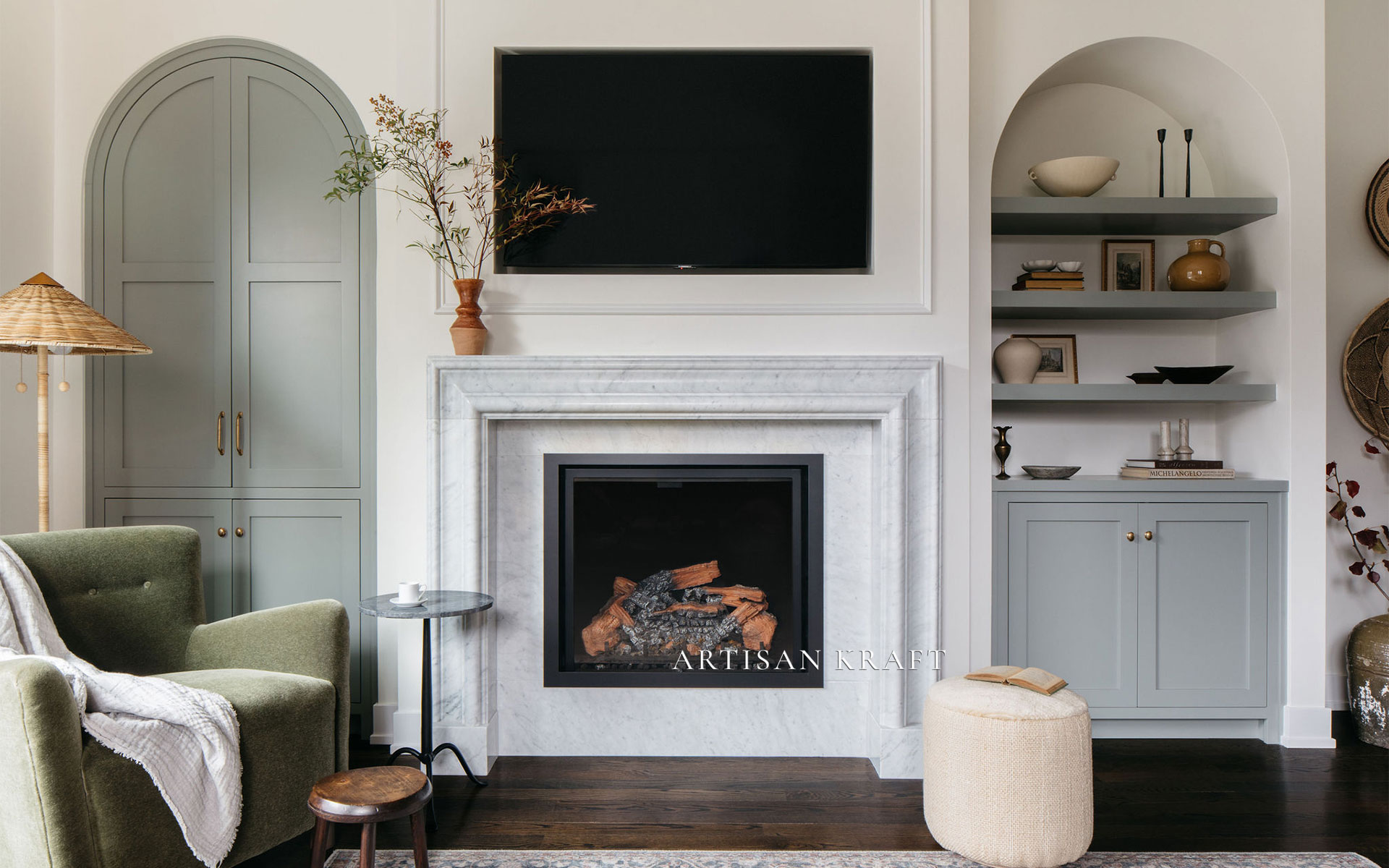
The Modern Bolection in Bianco Carrara marble. Design by Corey Lohmann; photo by Margaret Rajic.
Marble is the luxury choice — defined by its natural veining, polished finish, and depth of color. It ranges from the soft gray of Bianco Carrara to the dramatic contrast of Nero Marquina to the creamy Statuary White. Marble is equally at home in formal traditional interiors and minimalist modern spaces. Choose it when you want the mantel to feel like jewelry for the room.
Limestone
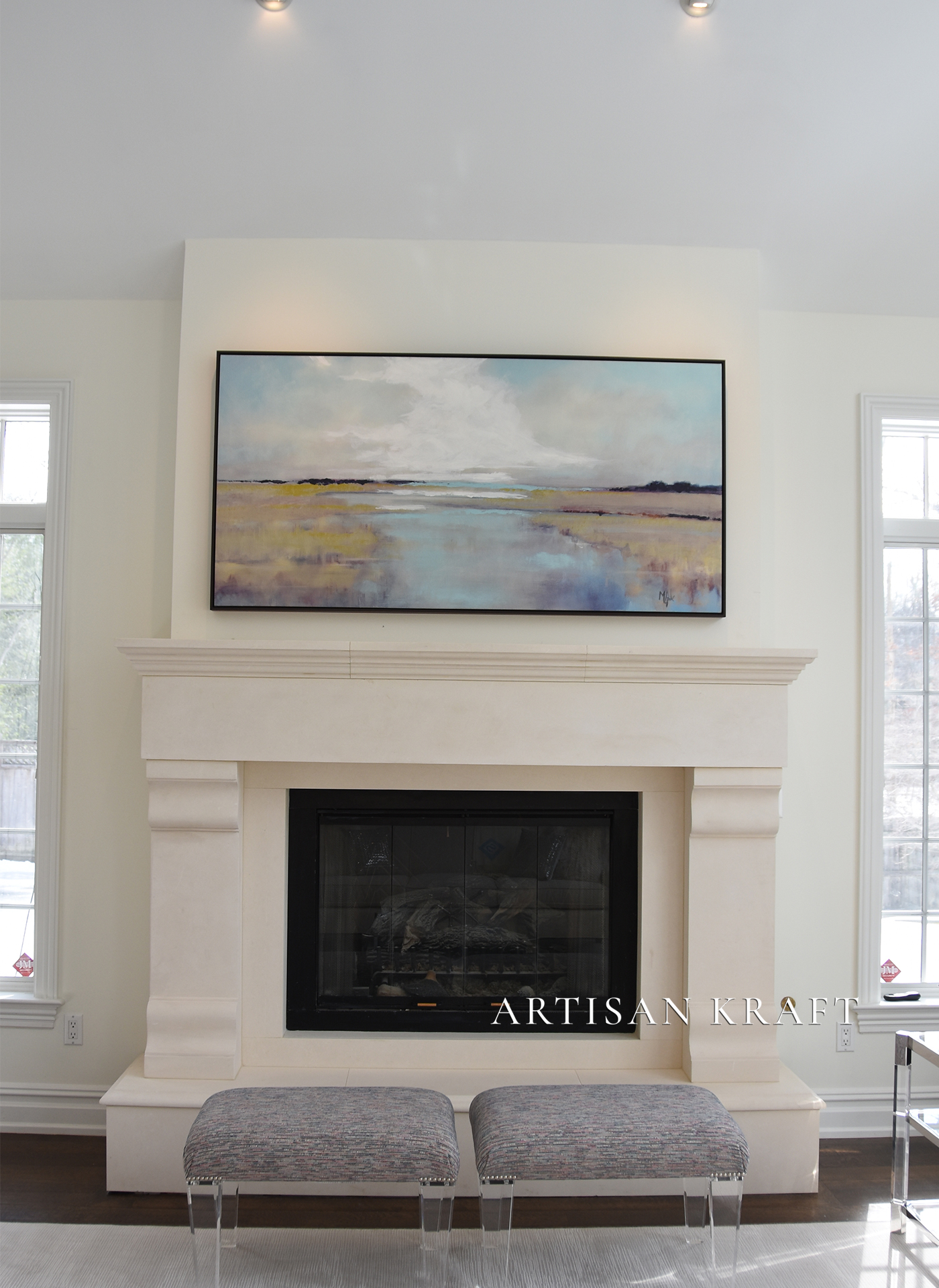
The Winnetka in Cream Limestone — our most sought-after traditional design.
Limestone is softer, matte, and more forgiving than marble. It reads as understated and architectural — the traditional stone for French chateaux, English country houses, and transitional American homes. Limestone ages quietly and beautifully, making it ideal when you want the mantel to feel like it has always been there.
Cast stone
Cast stone is manufactured from natural limestone as its primary aggregate, delivering the visual feel of carved limestone at a more accessible price. Because it is cast rather than quarried, it allows seamless mantel shelves and jambs — avoiding the stacked, seamed look common in lower-grade precast mantels. All of our cast stone fireplace mantels are manufactured in the United States from domestically sourced limestone. Choose cast stone when you want the limestone look, a custom size, and strong value.
Travertine
Travertine brings earthy, honeycomb texture and warm ivory-to-gold tones — ideal for Mediterranean, Spanish Colonial, and organic modern interiors. It is the most visually geological of the four materials and pairs beautifully with natural woods and warm metals.
The advantage all four share: ASTM E84 non-combustible construction
Every Artisan Kraft fireplace mantel — whether marble, limestone, cast stone, or travertine — is non-combustible and meets ASTM E84 fire-resistance standards. This matters more than most homeowners realize.
You may have read that fireplace mantels must sit at least 12 inches above the firebox opening. That rule applies to combustible (wood) mantels, not to stone. It comes from Section R1001.11 of the International Residential Code and exists to keep flammable materials away from heat. Because our mantels are non-combustible, they are not subject to that combustible clearance rule. The practical benefit: you have substantially more design flexibility in how the mantel relates to the firebox. You can place the mantel closer to the opening, choose deeper projections, and design with proportions that wouldn't be possible with a wood mantel.
Installation still needs to follow the fireplace manufacturer's instructions and any local building codes — factory-built and gas fireplaces often specify their own clearances regardless of mantel material — but the starting point for a stone mantel is far less restrictive than for wood. For the full technical details, see our Fireplace Mantel Building Code and Clearance Guide.
Step 5: Match the style to your home
The mantel should reflect the architecture of your home more than any current trend. A few starting points:
- Modern and contemporary — Clean-lined silhouettes like the Modern Bolection, or fluted and reeded designs. Particularly striking in Carrara or Statuary White marble.
- Transitional — The Winnetka (double-corbeled legs, cornice shelf) or the Traditional — two of our most versatile designs and the strongest for long-term resale value.
- Classic French and English — Hand-carved detail, defined corbels, pilasters. Cream Limestone is the traditional choice and ages beautifully over decades.
A note on custom mantels
Most homeowners are well served by a standard S, M, or L size because they map onto the most common American firebox dimensions. Consider custom when:
- Your firebox is non-standard (common in historic homes and modern linear fireplaces)
- You need the mantel to align with existing millwork or built-ins
- You want a stone or finish not offered in the standard catalog
Lead time for hand-carved natural stone is typically 16 to 20 weeks. Any of our designs can be made fully bespoke to your exact firebox.
Frequently asked questions
How wide should a fireplace mantel be?
A mantel should extend 3 to 6 inches beyond the firebox opening on each side. For a 36-inch firebox, that's a mantel 48 to 60 inches wide.
How high should a mantel shelf be from the floor?
The standard is 54 to 60 inches from the finished floor. Go to 60"–66" for 10-foot ceilings, and 66"+ for vaulted spaces.
Does a stone mantel have the same clearance requirements as a wood mantel?
No. The 12-inch minimum clearance rule found in the International Residential Code applies specifically to combustible mantels — that is, wood. Artisan Kraft mantels are non-combustible and meet ASTM E84 fire-resistance standards, so they are not subject to that combustible clearance rule. Installation should still follow the fireplace manufacturer's instructions and any applicable local building codes.
Marble, limestone, or cast stone — which should I choose?
Marble for luxury and polished veining. Limestone for a soft, classic, European feel. Cast stone for the limestone look in a seamless, custom-sized piece at a more accessible price point.
Can I put a TV above the mantel?
Yes — mount the TV no more than 4 to 6 inches above the mantel shelf, and keep the TV at least 30% narrower than the overall mantel width so the mantel still frames the television.
Ready to find your mantel?
Browse our full collection of handcrafted fireplace mantels in marble, limestone, cast stone, and travertine, or contact us for a custom quote. You can also reach us by phone at 888-652-0106, Monday through Friday, 9 am to 5 pm U.S. Central Time.
For over 20 years, Artisan Kraft has handcrafted fireplace mantels, range hoods, stone bathtubs, and architectural elements in marble, limestone, cast stone, and travertine. All of our mantels are non-combustible and meet ASTM E84 fire-resistance standards.